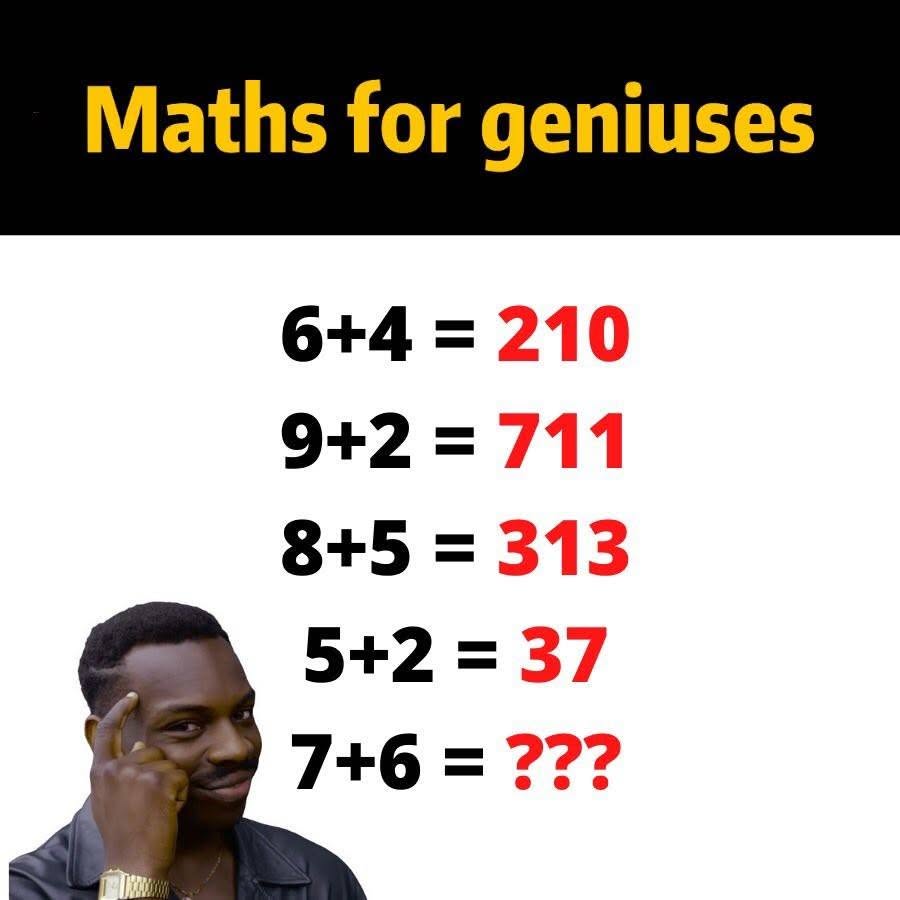
210
The first equation fits the pattern.
The Second Equation: 9 + 2 = 711
Now consider:
9 + 2 = 711
Find the difference:
9 − 2 = 7
Find the sum:
9 + 2 = 11
Put the two results together:
7 + 11 → 711
Again, the pattern works perfectly.
The Third Equation: 8 + 5 = 313
Now look at:
8 + 5 = 313
The difference is:
8 − 5 = 3
The sum is:
8 + 5 = 13
Put them together:
3 + 13 → 313
Once again, the answer matches the puzzle.
The Fourth Equation: 5 + 2 = 37
The final example is:
5 + 2 = 37
Find the difference:
5 − 2 = 3
Find the sum:
5 + 2 = 7
Put the two results together:
3 + 7 → 37
The same rule works again.
Now Solve the Final Puzzle
The final equation is:
7 + 6 = ???
Following exactly the same pattern:
Step 1: Find the difference
7 − 6 = 1
Step 2: Find the sum
7 + 6 = 13
Step 3: Put the two results together
1 + 13 → 113
Therefore:
7 + 6 = 113
The Hidden Rule
The entire puzzle follows this simple pattern:
Difference + Sum = Final Answer
More precisely, the answer is formed by writing the difference first, followed immediately by the sum.
For two numbers, A and B:
A − B = Difference
A + B = Sum
Then:
Difference + Sum → Final Answer
For example:
8 + 5
Difference:
8 − 5 = 3
Sum:
8 + 5 = 13
Final answer:
313
Why Is This Puzzle Tricky?
The puzzle is designed to make your brain automatically use ordinary arithmetic.
When you see:
6 + 4
your brain immediately thinks:
10
But the answer displayed is:
210
That apparent contradiction encourages you to search for another explanation.
The real challenge is not performing difficult mathematics. It is recognizing that the puzzle is using a different rule.