
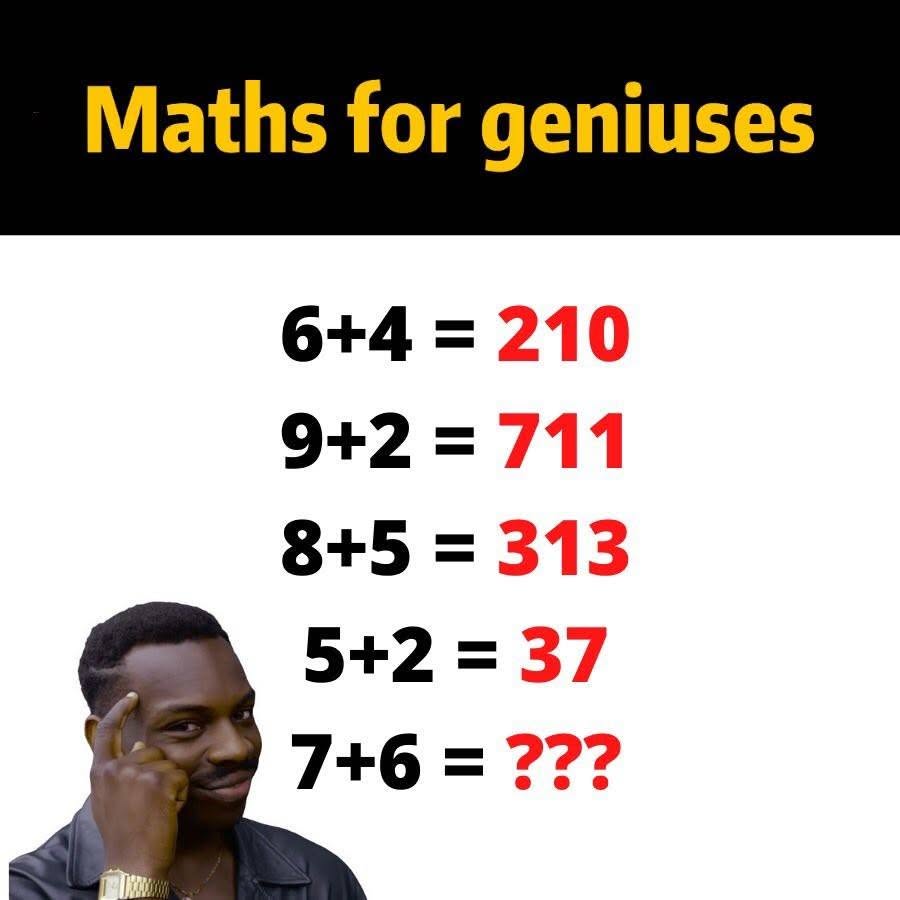
This is why these puzzles are often described as tests of logical thinking rather than mathematical ability.
What Skills Does This Puzzle Test?
Number-pattern puzzles can encourage several useful thinking skills, including:
- Logical reasoning
- Pattern recognition
- Creative thinking
- Attention to detail
- Flexible problem-solving
- Patience
- Analytical thinking
These skills can be useful not only in mathematics but also in science, programming, engineering, and everyday problem-solving.
Why Can People Find Different Answers?
Some pattern puzzles can have more than one possible solution.
This happens because people naturally look for different relationships between numbers.
A person might discover a rule that works for one or two examples but fails on the others.
The strongest solution is normally the one that explains all of the examples consistently.
In this puzzle, the difference-followed-by-sum rule works for every equation:
- 6 + 4 → 2 and 10 → 210
- 9 + 2 → 7 and 11 → 711
- 8 + 5 → 3 and 13 → 313
- 5 + 2 → 3 and 7 → 37
- 7 + 6 → 1 and 13 → 113
Try Creating Your Own Puzzle
Once you understand the pattern, you can create your own.
For example:
12 + 7 = ?
Difference:
12 − 7 = 5
Sum:
12 + 7 = 19
Final answer:
519
Another example:
15 + 9 = ?
Difference:
15 − 9 = 6
Sum:
15 + 9 = 24
Final answer:
624
You can use the same idea to challenge your friends and family.
Tips for Solving Similar Number Puzzles
When you encounter a puzzle like this, try the following approach:
- Don’t assume the symbols have their normal mathematical meaning.
- Compare all of the examples.
- Look for repeated relationships.
- Try subtraction, multiplication, division, or combinations of operations.
- Check whether the answer might be made by joining two separate results.
- Test your theory against every example.
- Choose the simplest rule that consistently explains the entire puzzle.
The key is to avoid forcing a rule that only works for one example.


