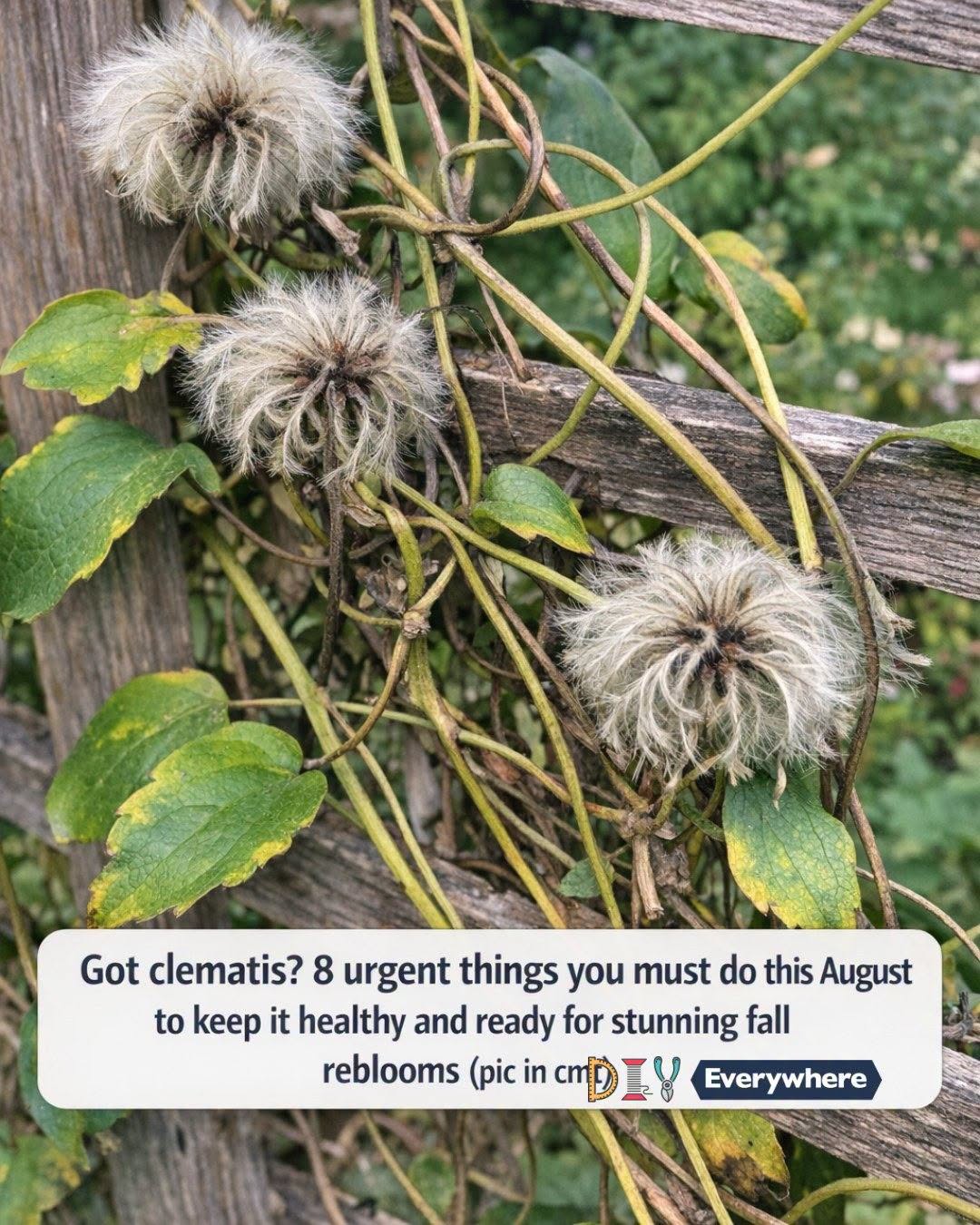
August is when my clematis either rewards me or humbles me. Here in the Midwest, that late-summer stretch of hot afternoons, dry spells, sudden thunderstorms, and muggy nights can make a healthy vine look tired in a hurry. But it is also the month that really sets the stage for those beautiful fall reblooms, especially on the repeat-blooming types. If your plant looks a little scraggly right now, don’t give up on it. A few timely jobs this month can make a real difference.
I’ve learned, usually the hard way, that clematis does not need fussy pampering so much as smart attention at the right moment. In August, I focus on moisture, airflow, light feeding, cleanup, and a little gentle training. Below are the jobs I make time for every year, including what to look for, how much to do, and a few simple adjustments if you have a young plant, a mature vine, or a picky garden spot.
1. Check which kind of clematis you have before you touch the pruners
This is the first urgent job because August care depends on whether your clematis blooms on old wood, new wood, or both. If you have a large-flowered repeat bloomer like ‘Nelly Moser’, ‘The President’, ‘Dr. Ruppel’, or ‘Jackmanii Superba’, it often benefits from gentle deadheading and light tidying now. If you have a heavy spring bloomer that flowers mostly on old wood, you need to be much more careful.
A simple way to sort it out is to think back to when it bloomed most heavily. If it had a big flush in late spring or early summer and is capable of a second round, August care should be light and supportive. If it blooms mostly from midsummer into fall on fresh growth, you still do not want to hard-prune in August, but you can be a little more confident about trimming weak, messy stems. I keep a plant tag in a garden journal because by August, after soccer carpools and canning tomatoes, I never trust my memory.
2. Water deeply, not frequently, and aim for 1 to 1.5 inches per week
Clematis roots hate drying out, and August heat can stress them fast. I try to give established plants the equivalent of 1 to 1.5 inches of water per week, including rainfall. In practical terms, that usually means a slow, deep soak once or twice a week instead of a quick sprinkle every evening. A mature vine often needs about 2 to 4 gallons at a watering, depending on soil type and size.
If your soil is sandy, you may need to water every 3 to 4 days during a stretch of 90-degree weather. In heavier clay, once a week may be enough if you water slowly so it penetrates 8 to 12 inches down. I use a hose on a slow trickle for 15 to 30 minutes at the base rather than spraying the leaves. Wet foliage overnight invites trouble, especially powdery mildew and leaf spot. Young first-year clematis need closer watching and usually dry out faster than older, settled-in plants.
3. Mulch the root zone to keep roots cool and evenly moist
One of the oldest clematis tips is still one of the best: cool roots, sun on the vine. In August, I refresh mulch if it has thinned out to less than 2 inches. A layer 2 to 3 inches deep of shredded bark, compost, leaf mold, or clean straw helps hold moisture, buffers temperature swings, and keeps weeds from stealing water.
Keep the mulch about 2 inches back from the stems so you do not trap moisture directly against the crown. I learned that lesson after losing a young plant in a soggy year. If you do not like a bare mulch circle, tucking in a shallow-rooted companion nearby can help shade the ground. I’ve had good luck with low annuals and small clumps of alyssum, but I avoid anything aggressive that will compete too hard.
4. Deadhead spent flowers and seedheads to redirect energy